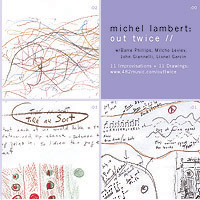
Michel Lambert divided his drumming leadership between two trios on Out Twice, one
with pianist Milcho Leviev and bassist John Giannelli, and the other with bassist Barre Phillips and
saxophonist Lionel Garcin. He also split his recording venues between American and European
sites.
Both ventures were unique; Lambert used his personal drawings and sketches as inspiration for
the trios in their free interpretation of music and its relationship to visual art. Lambert’s drawings are
linked individually to most of the tunes on the disc. The musicians reacted to this form of guidance in
lieu of traditional notation, permitting the pieces to be personal musical articulations of the visual
impact they experienced through the artwork.
The music ends up wide open, giving vent to free expression by all participants, similar to the
freedom exhibited in Lambert’s drawings. The common ground between the two groups is the
leader's drumming. He is a subtle director, offering cushioned blows, quieter rolls, and softened
beats to spur the bands into improvisational territory. Lambert underpins the band with rhythmic
patterns as abstract as his artwork. He is communicating what he is hearing, as opposed to what the
others are viewing, thus providing a wide percussive platform upon which all can create.
In both scenarios Lambert chose strong bassists as anchors. Giannelli and Phillips encompass
the music with a dense bass cloak – Giannelli allowing his improvisations to flood over the deep
keyboard ponderings of Leviev, and Phillips pouring fuel on the fire created by Garcin’s blowing.
In addition to the difference in group configuration, or maybe because of it, the output takes on
contrasting characteristics. Garcin opens his reeds widely, freelancing with a spurting attack to
catapult his trio into jagged, broken terrain. This causes Phillips and Lambert to take complementary
tacks with their bass/drum lines, and the music soars on high with unbridled, liberated exuberance.
In the piano trio context with Leviev and Giannelli, the music leans more toward the somber side,
casting deeper shadows of weighty proportion and darker coloration. Leviev broods over the keys
with absorbing intensity while the bass/drum interaction takes a commanding subterranean
view.
Starting with optic motivation and ending in auditory response, Lambert’s project is an
unqualified success. Music with character and originality flows from his trios, even though the paths
these artists take are widely divergent. The recording abounds with complexity and challenge,
making it a ready source of aural satisfaction.
Visit 482 Music on the web.
~ Frank Rubolino